Joyce Weiss

I work with organizations and individuals who want to kick conflict and chaos to the curb - Queen of Conflict Resolution and Communication Coach

  • Home
  • Services
    • Private Coaching Options
    • Work with Joyce
  • Why Hire Joyce
    • Testimonials-Resolve Conflict at Work
    • About Joyce: Conflict Resolution Coaching
  • Articles & Videos
    • How to Manage Dangerous Bullies at Work
    • Communication Strategies to Resolve Conflict in the Workplace
    • Personal Growth Strategies to Manage Inner Stress
    • Team Building Strategies to Reduce Conflict at Work
    • Verbal Communication Strategies to Sharpen Your Career
  • Blog
  • Grab Joyce’s Book
  • Contact
    • Contact Joyce
    • Share Joyce’s Articles

January 13, 2026 By Joyce Weiss Leave a Comment

Why Silence Feels Safe – But Isn’t

Several clients have shared that silence feels safer than rocking the boat. “Niceness” becomes a problem when it keeps people silent, resentful, or invisible. The real goal—at work and at home—is respectful honesty, not constant pleasantness.

The myth of “niceness” in everyday life

Many people stay quiet because they “don’t want to hurt anyone’s feelings,” even when something really matters to them.
Over time, that can lead to burnout, one‑sided relationships, and feeling unheard in both professional and personal life.

Why silence can be more harmful than speaking up

Avoiding hard conversations doesn’t make tension disappear; it pushes it underground.
Unspoken frustrations often show up later as passive‑aggressive comments, distance, or sudden “blow‑ups” that surprise everyone.

Being direct without being harsh

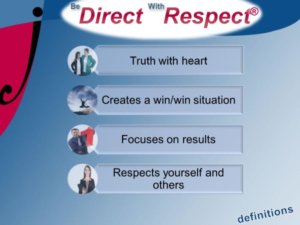
Being direct is not the opposite of being kind; it is a form of respect.
Clear, compassionate honesty gives other people a fair chance to understand you, adjust, or collaborate on a solution.

A simple “Be Direct with Respect®” check before you speak:

  • Am I being clear about what I think, feel, or need?
  • Am I speaking in a way I would find respectful if the roles were reversed?

The cost of the “nice at all costs” habit

At work, over‑niceness can look like:

  • Saying “It’s fine” when a boundary has been crossed or a commitment is repeatedly missed.
  • Taking on more than is reasonable because it feels rude to say no.

At home, it can look like:

  • Agreeing to plans you don’t want, then feeling resentful.
  • Avoiding topics (money, chores, parenting, in‑laws) because you fear “starting something.”

In both places, the result is the same: your needs stay invisible, and real connection never gets a chance to deepen.

Practicing “Be Direct with Respect®” at work and home

You can start small by pairing honesty with care:

  • Work: “I appreciate the effort you’re putting in, and I also need the report by Thursday so I’m not scrambling on Friday.”
  • Home: “I love our time together, and I need one quiet evening this weekend to recharge.”

Helpful sentence starters:

  • “There’s something I’ve been avoiding bringing up, but it matters to me…”
  • “I care about our relationship, so I want to talk about this directly rather than let it build up.”

A question for reflection

Where are you being “nice” instead of being honest—at work or at home—and what is it costing you?
If this resonates, consider one conversation this week where you choose to Be Direct with Respect®, even in a small way.

______________________________________________________________________________________

Let’s Stay Connected

Reach out at Joyce@JoyceWeiss.com if you are ready to break your silence and speak with confidence and courage.

Let’s make this the year to be heard, respected, and master the skills to resolve conflict.

______________________________________________________________________

Until next time,
Joyce Weiss M.A., CSP, CVP
Communication Coach Specializing in Conflict Resolution

To a Healthy Conflict Day!
And Remember, “You Get What You Tolerate!” Will it be CHAOS or CALM?


#SpeakUp
#FindYourVoice
#StandOut

Filed Under: be bold, Coaching Strategies
Tagged With: constructive feedback, effective communication, personal development

February 16, 2021 By Joyce Weiss Leave a Comment

A Motivational Quote to Remember During Healthy Conflict

Healthy Conflict is a term that surprises people at times.  Yes, conflict can be both healthy and unhealthy.

The next time you need to give constructive feedback, make sure it’s constructive (healthy conflict) and not sarcastic and full of revenge.
This is a great quote to remember when others give you destructive feedback.  Remember this person doesn’t have the great communication skills that you have while you are learning how to be a MASTER Communicator while reading these articles! 🙂 Just saying.

Every coaching client who works with me knows the importance of getting great results during tough conversations and not concentrating on being right.


healthy conflict | Winston Churchill

Let’s Stay Connected!

How does Churchill’s quote “speak” to you?  Those of you who share either in the comment section below or send me an email will receive a new video (that I have not posted yet) about using props to engage your virtual meetings. It’s short and contains tips to liven up your virtual meetings.

Hey, Dear Readers, I’m here for you when you have questions about your own communication or relationship “challenges.” Feel free to send me an email. Full disclosure here:  I don’t charge anything when people send me questions or comments via email. Staying connected is what it’s all about for me.

Have a Great Week!

Joyce Weiss, M.A., CSP, CVP
Master Coach
Queen of Conflict Resolution

P.S. Career Advancement is like riding a bike: Shift Gears from coasting to owning the road!

P.P.S. Grab the link for your FREE Kick Conflict to the Curb Communication Assessment to see how your communication impacts your success.

Filed Under: constructive feedback, motivational quote, Winston churchill
Tagged With: Conflict and Resolution Specialist, constructive feedback

November 24, 2020 By Joyce Weiss Leave a Comment

Control Your Triggers for Less Drama During the Holidays

  • Do you know how to control your triggers?
  • Would you like a little inspiration on how to stay positive when you are with people who irritate you?
  • Are you tired of people complaining about their life yet don’t do anything to change?

Welcome to my world! I recently took a class at the World of Business and Executive Coaching Summit (WBECS) and the speaker seemed to talk just to me. 🙂
She explained how coaches attract people who are working on the same issues as the coach.  I delved into that statement and I was amazed at how true it is.  Clients call me to so they can feel more confident in their communication with bullies and other tough situations. You know, that I’m the Queen of Conflict Resolution and know all about triggers! 🙂

So what about you? Look at the people in your life.  What kind of friends or colleagues do you seem to attract? The great news is when we attract people with the same positive qualities as you.  The bad news is when we also attract negative triggers (people or situations that become stressors for us).

Joyce, How Can We Control Our Triggers?

  1. It’s not easy! The first step is to know your triggers. Who or what causes you to react negatively?
  2. Now that you know your triggers, plan how you will stop yourself from reacting.
  3. You can walk out of the room, tell them that you have an appointment and get off the phone, or do your best to stay away from them.
  4. We all need support these days. We also need kind honesty and feedback when we don’t see negativity seeping into our conversations.
  5. Constructive feedback is a gift when it’s done with good intentions.

There may be times when you MUST be with your triggers. Not to worry.
I suggest that you look at them as a chair. You don’t get mad at a chair for being a chair. Don’t get mad at people for who they are – it’s usually their issue and not ours.  We make it our issue and we can stop that once we know that we can change our internal conversations.  Stop saying, “I can’t take him or her anymore” to “I’m in control of how I feel and you are a chair, so you can’t really push me!”
This is definitely a strange way to talk to yourself. It works, so try it before you roll your eyes. 🙂


How Does Wonder Woman Control Her Triggers? Triggers

I love Gal Gadot’s role as Wonder Woman.  I saw a recent quote of hers,

I do me.
You do you.
I’d rather have you not like me at this moment than not saying my truth.

When we control our triggers, we have a better chance of what comes out of our mouths. This will be your magic sauce!

Do your best to step back and think what the best solution is for you.  Is it better to be silent or speak your truth? We can control our triggers once we realize that we have choices on how to react.

Let’s Stay In Touch

Please share how you control your triggers in the comment section. What is your secret sauce? What issues are you still having with your triggers?

I’m here as your own Master Coach. Send me an email HERE if you have a private question to ask.

Until next time,
Joyce Weiss, M.A., CSP
The Queen of Conflict Resolution

PS I hope that these ideas will help you enjoy your holidays –  especially when those irritating people open their mouths.


Filed Under: negative people, triggers
Tagged With: constructive feedback, control your triggers

August 6, 2019 By Joyce Weiss Leave a Comment

Accountability Strategies to Build a Powerful Team: Part 5

https://youtu.be/u4Eyh6JEJ1k

  • Are you ready to learn 3 new accountability strategies to support your team to become accountable for its actions?
  • Do you want your team to feel comfortable with constructive feedback?
  • Are you willing to act proactively with your team when they need to become more accountable?

If you answered yes to any of the questions, you are in the right place!
Welcome to Communication Skills at Work, the place where leaders learn how to kick conflict to the curb, to earn the respect they deserve!

Today’s video and blog article will give you and your team 3 new accountability strategies to help your team change it’s mindset to one of accountability and responsibility.

Sound good?  Let’s go deeper!

The links below cover Parts one to four in the five-part series:

Accountability Strategies part one

Accountability Strategies part two

Accountability Strategies part three

Accountability Strategies part four

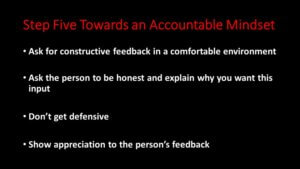
Accountability Strategy #One:  Support Your Team to Feel Comfortable Giving and Receiving Constructive Feedback

accountability strategies


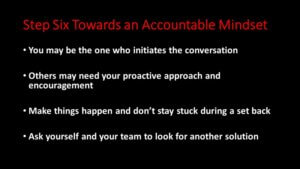
Accountability Strategy # Six:  Accept Your Responsibility to Initiate Conversations with Your Team

accountability strategies

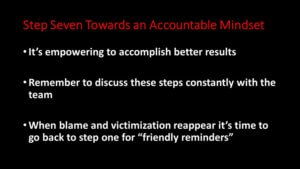
Accountability Strategy # Seven:  Remind Your Team to Become Accountable and Responsible

accountability strategies

I want to Hear From You

Add a comment to my blog on how you create a team where accountability is the norm.  What challenges do you experience with resistance from some team members to become accountable?  You will receive a response from me because I enjoy connecting with my readers! 🙂  You are always welcome to send me a private email with concerns that you are experiencing at work.

Stay Connected with Joyce

Please contact me at 800.713.1926 to explore how career coaching could be a great action step for your career development.
There are many options to fit your budget and time schedule! 🙂

Until next time,

Joyce Weiss, M.A., CSP
Career Coach and Corporate Communication Strategist

Have a great week.

Remember, YOU Get What YOU Tolerate!

The links below cover Parts one to four in the five-part series:

Accountability Strategies part one

Accountability Strategies part two

Accountability Strategies part three

Accountability Strategies part four

Filed Under: accountability strategies, change culture
Tagged With: constructive feedback, personal accountability

December 4, 2018 By Joyce Weiss Leave a Comment

Communication Strategies to Use with Someone who Didn’t Receive a Promotion

Communication strategies will be the topic for the next few posts.  You will find case scenarios taken from recent Be Direct with Respect® workshops.

The following Topics will be covered:

  • How to deal with someone who constantly complains about being passed over for a promotion
  • How to have a tough conversation with a direct report who brings problems from home to work
  • Having a direct conversation about mediocrity
  • How negativity lowers morale

Have you dealt with any of the following issues?

  • A colleague didn’t receive a promotion and you don’t know what to say.
  • You want to tell a productive direct report that she needs to develop a couple of skills.
  • A friend is dwelling on how he was passed over a promotion.  You want to suggest that he moves on in order to look for more opportunities and not be so negative.

This article has 2 communication strategies to help you support a friend, colleague or direct report.

Communication Strategy #1:  Make the conversation safe

Make the conversation safe by starting it out with I do want – I don’t want.executive coach| communication strategies

Here are a few examples:

I don’t want to minimize the effort that you are making.
I do want to discuss how to improve your performance.

I don’t want to discourage you.
I do want to help you with your career.

I don’t want to dwell on what didn’t happen.
I do want to encourage you to look at this as an opportunity to refocus on career development.

I don’t want to lose you as an engaged member of our team.
I do want to discuss efforts to improve your future opportunities.

I don’t want to downplay the importance of what the promotion meant to you.
I do want to remind you of your strengths and all the things you bring to the team.

I hope that you get the idea.  You can make the conversation safe by using this strategy.  You can also change the words around by using I don’t want at the beginning or start out with I do want.  Everyone’s comfort level is different.

Communication Strategy #2:  Use Be Direct with Respect®

Be direct with respect® is a powerful communication strategy that allows you to be direct in a respectful way.  It is a communication strategieslearned skill; a willingness to risk rejection by communicating directly, yet gently.  It deepens relationships and resolves issues.

I am  ___________________
(Your emotional response)

When I __________________
(Non-judgmental)

Because __________________
(How it affects you)

I am concerned when I see you so down about not getting promoted because I believe you can get past this and achieve your goals.

I am concerned when I see your frustration because you can move forward in the organization.

I understand your situation when I see you disappointed because I want to see you keep going in the right direction.

These 2 communication strategies will give you a plan on how to approach this delicate subject with someone who may need some support.  Find more communication strategies in the search option of this blog.

I want to hear from you

Add a comment to my blog on how you have helped someone who didn’t get a promotion.  Let me know what other communication or conflict resolution topics you want me to write about to fit your specific needs. You will receive a response from me because I enjoy connecting with my readers! 🙂  You are always welcome to send me a private email HERE with concerns that you are experiencing at work.

Please share this and any article that speaks to you or your company

Loyal readers like you help us find more people who could benefit from these posts. Help us help them reduce conflict and improve leadership skills and quality of life.


Learn how I can leverage my 30+ years of leadership consulting and coaching experience to help your organization address conflict resolution in the workplace here.

This is Joyce Weiss
Corporate Communication Strategist and Career Coach

Have a great week.

Until next time, Remember…”You Get What You Tolerate!”


Filed Under: Career Development, Communication Strategies
Tagged With: constructive feedback, effective communication

  • 1
  • 2
  • 3
  • …
  • 7
  • Next Page »

YouTube player
If you like this video, please subscribe to my YouTube channel for more:

Contact Joyce

Email: joyce@joyceweiss.com
Phone: 248-681-5831

  • Facebook
  • LinkedIn
  • YouTube

Legal Terms & Conditions

  • Terms of Use
  • Privacy Policy
  • Earnings Disclaimer

Copyright © 2026 Joyce Weiss Training and Development, LLC.


WordPress Design and Development by jhWebWorks, LLC